The aim isn't to complicate a shipment, quite the opposite. It's to identify the complications early enough that the customer doesn't have to deal with them later, resulting in unnecessary cost.
Imagine you've spent months preparing for a shipment. The vessel is booked, the port is confirmed, the crane is ready and everyone involved expects loading to begin on schedule. Then something doesn't quite add up, and what looked like a formality now needs settling before anyone can proceed.
These situations are more common than people outside the industry might realise, and in a heavy lift operation, even a small detail can be the difference between proceeding as planned and stopping to reassess while the vessel, crane and contractors wait. This is why experience matters.
What Experience Really Buys You
Customers care about one thing: the vessel arrives in one piece, on time, on budget. What they don't see is everything standing between that outcome and the quote they signed off months earlier.
Experience isn't measured by how many shipments a team has completed, it's measured by how many ways a shipment can go sideways, and how quickly you spot one starting to happen. Across ferries, superyachts, workboats and specialist marine cargo, our teams have hit most of the variations, and that's what tells them what to question, what to check twice, and where the margins are tighter than the paperwork suggests.
Sometimes that means asking for another measurement or photograph. Sometimes it means revisiting an engineering calculation or reconsidering a proposed vessel. And sometimes it means making a decision on the quayside because something that worked on the drawing can be improved once the operation is happening in front of you. The customer may never know any of those conversations happened. Most of the time, that's exactly how it should be.
Choosing the Right Vessel
Choosing the right vessel is one of the biggest decisions on any project, and it sits with Kyle Morant in Shipbroking and Paul Elsom, Global Technical Director. To many people, that sounds straightforward: find a ship with enough space and enough lifting capacity. In reality, it's rarely that simple.
Every vessel has different crane capabilities, deck layouts, stability characteristics and trading routes. A vessel might look suitable on paper but be unable to complete the lift safely for a variety of reasons, most commonly crane limitations that only become apparent once the vessel is analysed in detail. That's why vessel selection isn't made in isolation: Shipbroking, Commercial and Technical teams work closely together from the outset, challenging assumptions before any commitments are made, and every potential vessel is reviewed not only against the commercial requirements of the project, but also against the engineering realities of loading and discharge.
Before anything is confirmed, we'll look at whether the vessel can actually carry out the operation safely. It's much better to ask those questions before a booking is made than when the crane is already waiting.
Paul Elsom, Global Technical Director
That collaborative approach continues throughout the project: commercial decisions influence technical planning, while technical knowledge helps shape commercial decisions, and the result is a project that's been challenged from every angle before the operation even begins. Robert Blades leads the commercial side of that conversation.
The earlier we're involved, the more value we can add. We can identify potential issues before they become delays, advise on vessel selection, review technical information and work with the customer to make sure the project is set up for success from the very beginning.
Robert Blades, Commercial Manager
That's the difference between arranging a shipment and helping shape it before it even begins. Peters & May manages that process from vessel selection through technical planning, loading and final discharge, keeping the same teams connected throughout the project, which is why the same team is usually still involved when the customer calls back six months later with a different project.
A Lift Plan Is Never Just a Drawing
A lift plan isn't produced once and then treated as final. It keeps developing as new information comes in, and it doesn't take much to change the calculations: an exhaust not showing on the drawing, a stabiliser, a different fuel load or a previously unidentified deck structure can all be enough. What reaches Peters & May comes from the vessel's owner, and it's often a general arrangement or a pocket plan: a simplified document showing crane and deck sizes rather than the specific quirks and modifications of that particular vessel.
Cargo gets added late more often than people outside the industry might expect. One more yacht can be squeezed aboard, then another, and each addition can mean restowing and replanning work that was already finished, sometimes days before loading, occasionally the day before, or on the day itself.
Cargo weights aren't always as certain as the paperwork might suggest, particularly where vessels have been modified, fuelled or fitted with additional equipment. The technical approach is therefore to plan conservatively, allowing for the least favourable realistic case rather than assuming everything will arrive exactly as expected.
Where Planning Meets Reality
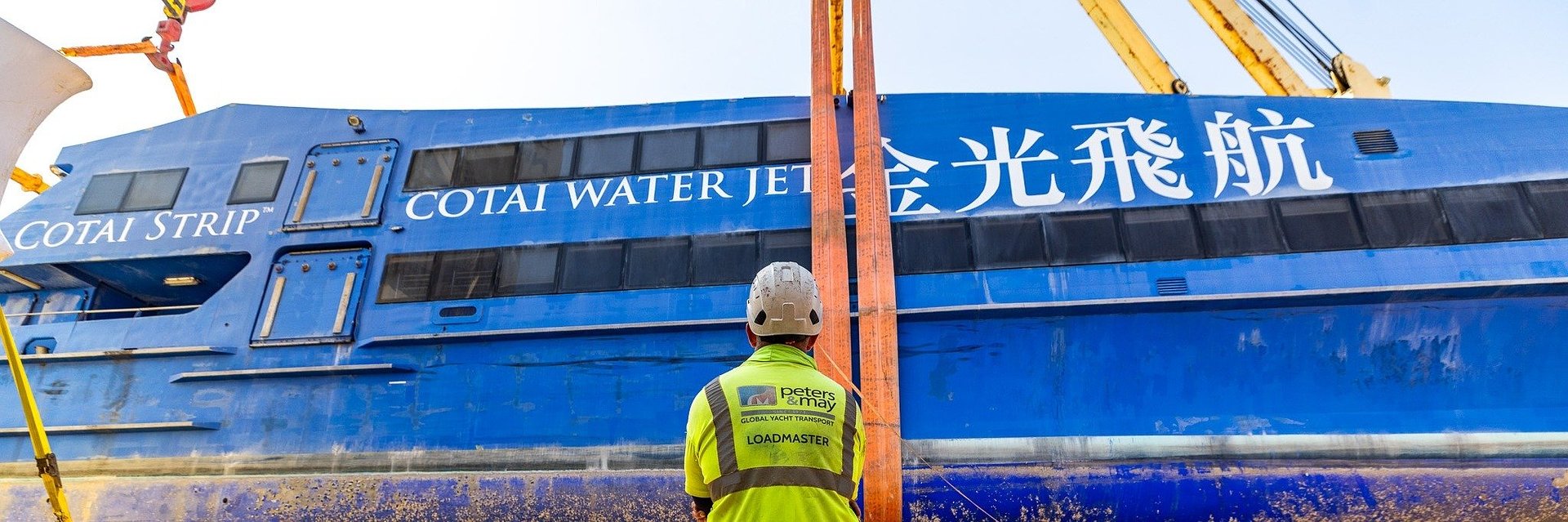
A recent shipment of two 47.5-metre ferries and two 26-metre Crew Transfer Vessels (CTVs), a combined 645 tonnes, provides a good example of what that looks like in practice. The cargo was discharged in stages across several ports, starting in Greece, and the ferries were loaded close to the technical limits of the available crane capacity.
At the bow, approximately 130 tonnes was being handled against around 160 tonnes of available crane capacity at the required position. At the stern, the lift was approximately 102 tonnes against around 120 tonnes of capacity, with the crane also at its maximum radius for the available hook height. Margins like that meant careful planning around lifting arrangements, available hook height and the sequence in which the cargo would be handled.
Even the way the ferries were supported required a bespoke solution. Flat racks were used beneath them to provide a more stable base than timber towers alone, with another positioned transversely to create the height needed for the supporting tripods beneath the overhanging bow.
The initial lifting plan worked, but execution isn't simply about proving that a plan works and then following it without question.
During the operation, Loadmaster Gavin Boyle could see that the stern rigging for the first ferry was operating at the limit of the aft crane. The lift could be completed, but having seen those working limitations in real time, Gavin identified an opportunity to improve the arrangement before handling the second ferry: shorter lifting belts, backloaded from Hong Kong and unavailable to the technical team during the original planning phase, meant that reconfiguring the lifting gear gained an additional two metres of working hook height.
In essence, it's about seeing the working limitations of the cranes in real time and reducing the risk of it not working before it happens.
Gavin Boyle, Loadmaster
It's a relatively small change when described on paper, but operationally, it demonstrates something much bigger. The original plan hadn't failed; the team had identified a tighter working margin during the live operation and used the equipment and experience available to improve it before it became a problem.
It matters, because experience isn't only valuable when something's already gone wrong. More often, its value is spotting the conditions that could cause a problem and doing something about them first, quietly, before anyone else even knows there was a risk.
Execution Is a Team Effort
That two-ferry operation also demonstrates why complex marine logistics can't be viewed as a series of separate tasks. Shipbroking helps identify a suitable vessel, commercial teams understand the customer's wider requirements, technical teams turn those requirements into workable engineering and lifting plans, operations coordinate the many parties involved, and eventually the plan reaches the loadmasters responsible for delivering it in a live environment. Each decision affects the next.
That becomes particularly important on multi-stage projects. This one called at four ports in turn, with twelve separate lifts, shifts and discharges between them, and the team isn't only thinking about the lift happening today, they need to understand how each movement affects the next stage of the voyage. For that shipment, the ferries needed to be discharged before the CTVs could be repositioned, so sequencing wasn't simply about getting individual pieces of cargo safely on and off the vessel; every movement had to support what needed to happen afterwards. This is where detailed planning and on-site judgement come together.
The Expertise Customers Rarely See
Heavy lift operations are inherently visual: a 47.5-metre ferry suspended from a vessel's cranes is impressive, and understandably that's the moment that attracts the cameras. But it isn't necessarily the moment that best demonstrates the expertise involved. Much of the work has happened before the hook moves, in selecting the vessel, reviewing drawings, checking measurements, understanding crane curves and working limitations, planning the rigging, considering the loading and discharge sequence, and identifying what could change and how those risks will be managed.
It continues on the quayside too, where someone has to look at the vessel actually in front of them and decide whether what was planned is still the best way to do it. Customers don't necessarily need to see every one of those decisions; they need to know that someone is making them.
Because when you're moving critical cargo that can't afford to go wrong, the value of an experienced logistics partner isn't simply getting it there. It's knowing exactly what to check along the way, and doing it before anyone has to find out the hard way.